
Why Your Garage Door Won’t Close in Reading, PA — And the Fix That Actually Lasts
If your garage door won’t close all the way, the most common cause in Reading is misaligned or obstructed safety sensors — but if the door starts down then reverses slowly, or grinds to a halt halfway, you’re likely dealing with track rust and rolling resistance from Schuylkill River valley humidity, not a sensor problem at all. Call (833) 324-1505 for same-day diagnosis; most repairs run $150–$600 and we stock parts for LiftMaster, Chamberlain, Genie, and Clopay systems.
We’ve spent 14 years crawling through Reading’s alley garages — from the narrow brick-lined passages behind South Side rowhouses to the converted carriage-house openings in Centre Park — and we’ve learned that “won’t close” means two completely different failures depending on how your door behaves. The national troubleshooting guides collapse both into one generic checklist. They’ll waste your Saturday.
Sensor Failure vs. Resistance Failure: Two Problems, One Symptom
Here’s the distinction that matters. When a safety sensor trips, your opener’s logic board receives an immediate stop signal. The door reverses fast — usually within 12 inches of starting down — and your opener light blinks four times (LiftMaster/Chamberlain) or flashes twice (Genie). That’s sensor failure. Clean the lenses, check alignment, verify nothing’s blocking the beam.
But when galvanized track rust builds rolling resistance, the opener motor strains against an invisible load. The door descends slower each week. It may stop at the same spot every time. The motor hums louder. Eventually the thermal overload trips before the door reaches the floor. No blinking light. No error code. Just a door that “won’t close” despite every sensor check coming back clean.
In Reading’s unventilated alley garages — especially the pre-WWII stock in Callowhill and Oakbrook where airflow is nonexistent — we’ve seen track interiors rust to orange dust while the exterior still looks presentable. The rollers bind. The opener’s close-force setting, factory-calibrated for smooth track, gets overwhelmed. Homeowners replace sensors twice before someone finally looks at the track.
Joseph Taylor, Owner & Lead Technician at Matrix Garage Door Repair Reading, spotted this pattern early in our work. “If I can’t fix it straight, I’ll tell you that before I touch it” — and straight means knowing which failure mode we’re actually chasing.
Three Checks You Can Do in Two Minutes
Before calling, run this sequence. It’ll tell you whether you’re facing sensor issues or resistance issues, and it’ll save you from buying parts you don’t need.
- Disconnect the opener and lift by hand. Pull the red emergency release cord. The door should glide up and down with one hand. If it feels heavy, sticks at certain points, or requires real effort, you’ve got spring fatigue, track rust, or roller binding — not a sensor problem. A properly balanced door weighs 8–10 pounds; anything more means mechanical resistance.
- Inspect the track interior with a flashlight. Look for orange-brown streaks, flaking galvanization, or gummed grease turning to paste. In Reading’s valley humidity, we see this accelerate every July and August when alley garages become steam boxes. Check the vertical sections where condensation pools — that’s where rust starts.
- Check sensor alignment last. Only after you’ve ruled out resistance. The LED indicators should glow steady (not flickering) on both units. Measure their height — they must match within ½ inch. Wave a broom handle through the beam while the door closes; it should reverse immediately. If it doesn’t reverse, the sensors are misaligned or failed.
If your door passes the hand-lift test smoothly but still won’t close, then you’ve isolated a true sensor or opener logic problem. That’s when we bring the multimeter and the brand-specific diagnostic charts — 14 years of hands-on training with LiftMaster, Chamberlain, Genie, Clopay, and the rest of the major lines.
Why Reading’s Alley Garages Rust Tracks Faster Than Suburban Bays
Reading sits in the Schuylkill River valley, and that geography doesn’t forgive metal. Cold air settles in these alleys overnight; morning sun hits the east-facing garage doors and flash-heats the humid air trapped inside. The galvanized coating on tracks — designed to sacrifice itself slowly — accelerates its own consumption in that freeze-thaw, wet-dry cycling. We’ve pulled rollers from South Side tracks where the galvanization was gone on the interior curve but intact on the exterior face. The door had been fighting that asymmetry for three summers.
The suburban garages in Wyomissing and Muhlenberg? Different story. Attached, insulated, ventilated through the house’s HVAC envelope. Their tracks last 15–20 years. The unventilated brick alley garages behind Reading’s 1900–1945 rowhouses? We’ve seen significant rust in 8–10 years, especially where the previous owner never lubricated or where DIY “fixes” involved WD-40 that stripped existing grease and left bare metal exposed.
This isn’t a design flaw you can blame on the builder. These garages were retrofitted decades after the original construction — often into spaces never meant for vehicles. The openings are non-standard (7–8 feet common, not the 9–16 feet suburban installers expect). The headers are sometimes brick arches bearing structural load. A technician who knows Reading’s housing stock recognizes these constraints immediately. One who doesn’t may recommend a door size or opener mount that fights the opening geometry from day one.
What the Repair Actually Costs — And What You’re Paying For
Once we’ve diagnosed the real cause, pricing is straightforward. We don’t quote over the phone for “won’t close” because we’ve been burned by assumptions — and we’ve burned customers by guessing. Here’s what Reading homeowners typically see after diagnosis:
| Service | Price Range | When It Applies |
|---|---|---|
| Track cleaning & lubrication | $120–$240 | Early-stage rust, no pitting, rollers still rolling |
| Roller replacement | $110–$220 | Sealed bearings failed, nylon cracked, steel wheels rusted |
| Track realignment or section replacement | $120–$240 | Impact damage, severe rust, or opener rail pull-off |
| Spring repair (torsion or extension) | $180–$340 | Door heavy in hand-lift test, visible coil gap or stretch |
| Opener repair | $120–$320 | Logic board, gear assembly, or force-setting failure |
| Complete Garage Door Repair (multi-component) | $150–$600 | Compound failures common in neglected systems |
The low end of each range covers straightforward access, standard parts, and single-component failure. The high end reflects compounded problems — rusted track plus fatigued springs plus an opener that’s been overworking for two seasons — or access challenges in tight alley garages where we disassemble the door to get the truck within working distance.
We carry inventory for LiftMaster, Chamberlain, Genie, and Clopay systems on every truck. When your opener is a Craftsman relabeled Chamberlain or a Raynor private-label unit, we know the cross-reference without looking it up. That’s 14 years of brand-specific knowledge, not a parts-counter guess.
The Maintenance Interval Reading’s Humidity Demands
Generic advice says “service your garage door annually.” For Reading’s alley garages, that’s wrong. We recommend track cleaning and lubrication once in May, before the valley humidity peaks, and a second check in October after the summer’s damage is done but before freeze-thaw cycling begins.
Here’s what that May service involves: remove the old grease that’s attracted dust and moisture all winter, inspect for galvanization failure starting at the track bottom curves, replace any roller with visible bearing rust, and apply a lithium-based lubricant that won’t wash out in humidity. We spend 20 minutes on a standard door, 35–40 on the tight-access alley units where we work around stored bikes, lawn equipment, and the accumulated belongings of decades.
Customers who’ve been on this schedule since we started offering it in 2016? Their track life has doubled. The ones who call every three years with “it just suddenly won’t close”? They’re usually looking at track replacement instead of maintenance. The math isn’t complicated.
When the Opening Itself Is the Problem
There’s a special case we see in Reading’s pre-WWII stock, and it’s the one that frustrates franchise technicians who keep swapping parts. If your door has never closed smoothly — not last year, not five years ago, not since you bought the house — the issue may be the opening geometry, not any single component.
Brick arch headers settle. Lintel beams sag. The rough opening dimensions that were “close enough” for a 1980s steel door fight a modern insulated Clopay or Amarr panel that’s built to tighter tolerances. We’ve walked into Centre Park carriage-house conversions where the header had dropped ¾ inch on one side, putting the entire door in twist. The previous company had replaced the opener twice, the springs once, and the rollers annually. Nobody measured the frame.
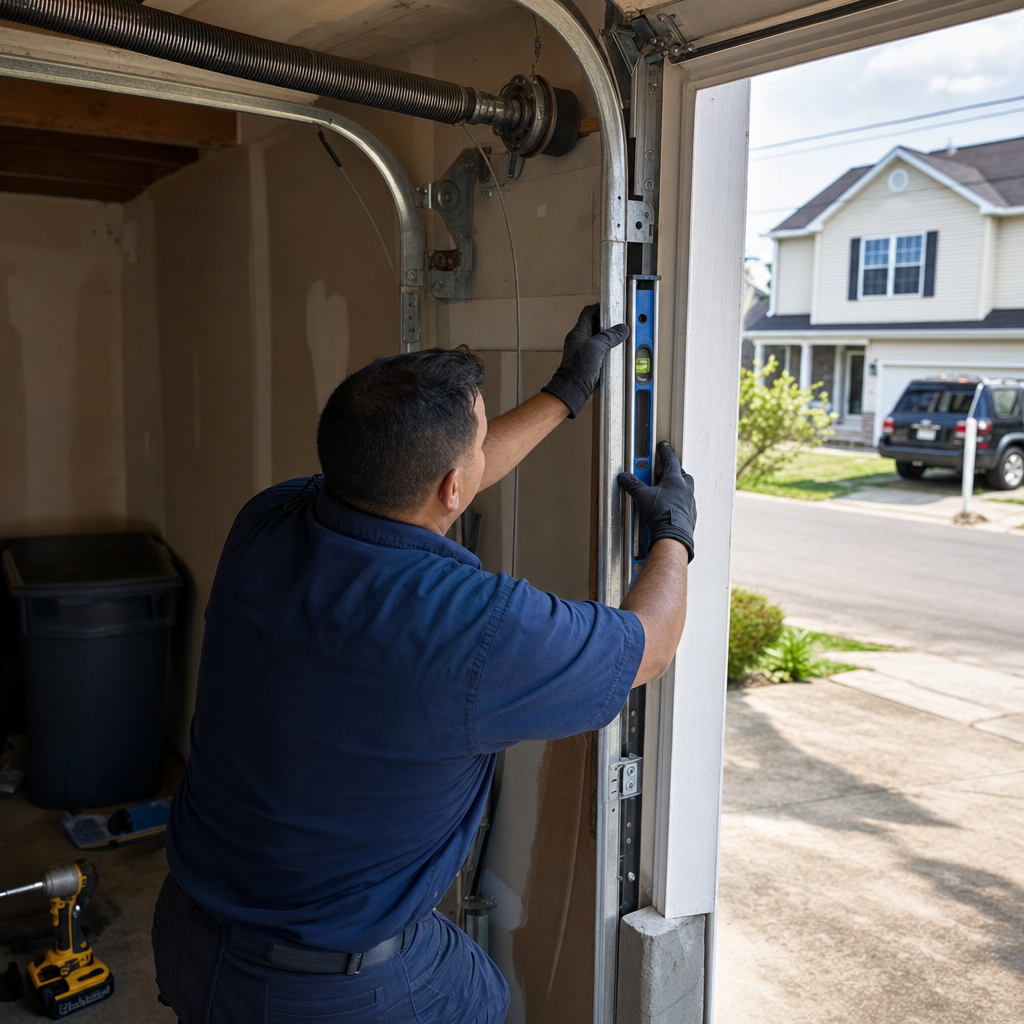
This is where 14 years in Reading’s specific housing stock matters. Joseph Taylor spots header sag in the first two minutes of a visit — it’s visible in the gap pattern between door and jamb, audible in the asymmetrical roller noise, measurable with a level we carry on every truck. Fixing it means sistering a steel header, sometimes rebuilding the masonry surround, before any door component gets touched. A suburban installer trained on standardized construction might never have seen this failure mode.
We’ve earned nearly 800 verified reviews — 779 at 4.8 stars — largely because we diagnose before we quote, and we quote before we work. No surprises on the invoice. No three-visit mystery.
FAQs
Most repairs for a garage door that won’t close in Reading run between $150 and $600, depending on whether it’s a simple sensor realignment or a multi-component failure involving rusted track, worn rollers, and an overstrained opener. For the best garage door repair in Reading, PA, we diagnose first, quote upfront, and stock parts for same-day completion on most jobs. We diagnose first, quote upfront, and stock parts for same-day completion on most jobs. Call (833) 324-1505 for a free estimate — we’ll give you a firm number after seeing the door, not a guess over the phone.
If your garage door closes halfway then reverses with no blinking light, the opener’s force sensor is detecting excessive rolling resistance — usually from rusted track, binding rollers, or spring fatigue — and interpreting it as an obstruction. In Reading’s Schuylkill River valley humidity, this happens most often in unventilated alley garages where galvanized track rusts internally while looking fine from outside. Disconnect the opener and lift the door by hand; if it’s heavy or sticky, you’ve got a mechanical resistance problem, not a sensor issue. We can confirm this in one visit and fix it same-day.
Yes — we carry parts for LiftMaster, Chamberlain, Genie, Clopay, and other major brands on every truck, and we offer emergency garage door repair in Reading, PA beyond standard hours because a broken door doesn’t wait for business hours. For typical “won’t close” calls in Reading, we’re on-site within hours and complete repairs in a single visit. Call (833) 324-1505 and we’ll give you a realistic arrival window.
Repair is almost always cheaper for a door that won’t close — replacement only makes sense if the door itself is structurally failing (rusted-through panels, delaminated insulation, or impact damage beyond panel replacement). For most Reading homeowners, a $180–$340 spring repair or $120–$240 track service restores full function at a fraction of the $700–$2,200 cost of new door installation. We’ll tell you honestly if your door has reached replacement point; we’ve walked away from jobs where the customer’s money was better spent on a new unit. Call (833) 324-1505 for an honest assessment.
When to Call Matrix Garage Door Repair Reading
If you’ve run the three checks above and the door still won’t close — or if you’d rather not spend your Saturday in a humid alley garage with a flashlight — we’re here. Joseph Taylor answers the calls and leads the repairs, so the expertise you speak with is the expertise that shows up. No subcontractors. No franchise script. Just 14 years of fixing garage doors in Reading’s rowhouses, twins, and converted carriage houses, backed by nearly 800 homeowners who’ve trusted us and come back.
Matrix Garage Door Repair Reading offers no-pressure assessments in Reading and surrounding areas. Call (833) 324-1505 for a free estimate, or visit our home page to learn more about our full range of services. For our complete repair capabilities, see Garage Door Repair in Reading.
Written by Joseph Taylor, Owner & Lead Technician at Matrix Garage Door Repair Reading, serving Reading, PA.