
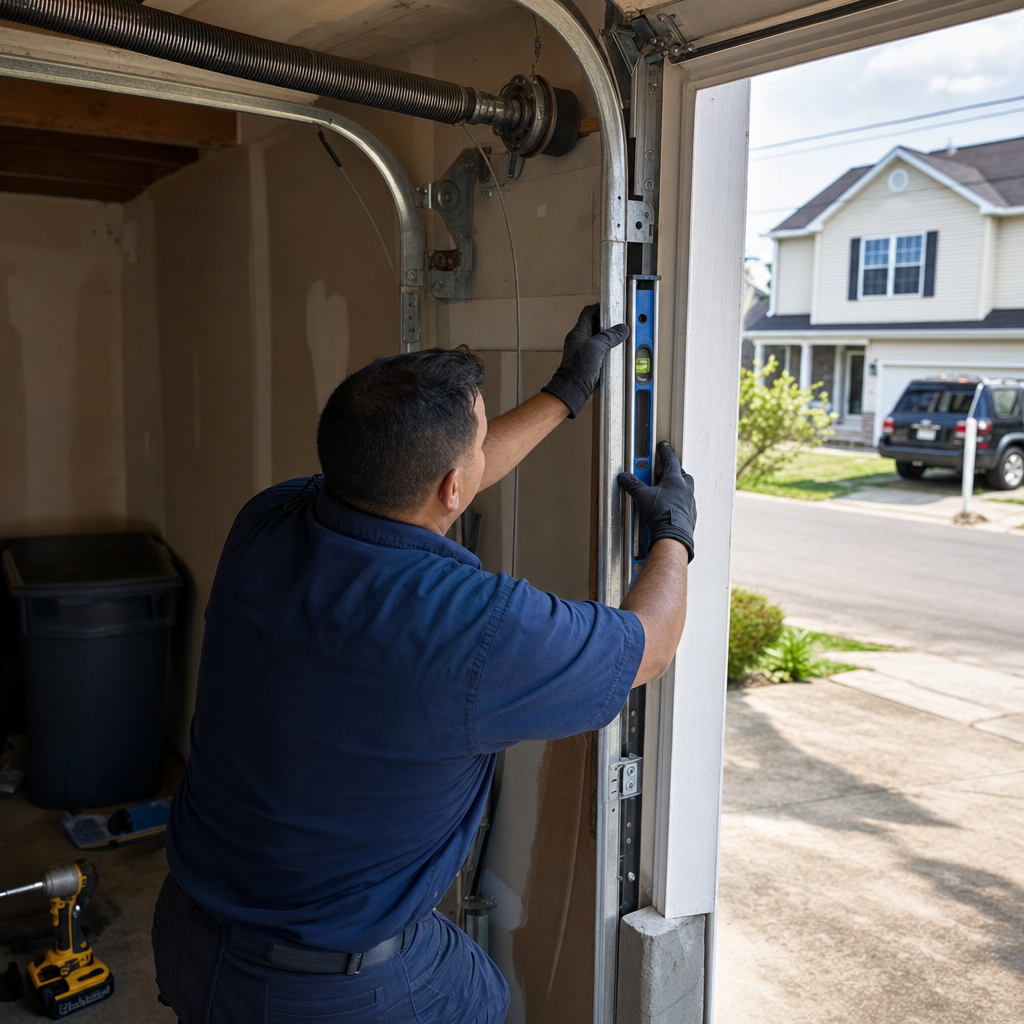
Why Does My Garage Door Reverse in Reading, PA?
The most common reason a garage door reverses before closing is that the opener’s safety system detected resistance or an obstruction — but in Reading, the real culprit is often a frozen bottom seal stuck to your concrete pad, not a misaligned sensor. If your door rises six inches and immediately comes back down on a February morning while your sensor lights stay solid green, you’re probably looking at a resistance-triggered reversal, not a photo-eye problem. Call us at (833) 324-1505 and we’ll walk you through a three-minute check before you spend money on the wrong fix.
We’ve been handling this exact scenario in Reading’s alley garages for 14 years, and it still surprises homeowners. The Schuylkill River valley traps cold air and moisture against those concrete pads, and when temperatures swing sharply between overnight lows and afternoon highs — common in February and March here — a rubber bottom seal can freeze solid by 7 a.m. even if the door operated fine the evening before. Your opener’s auto-reverse mechanism reads that resistance as an obstruction, reverses the door, and the sensor beam never breaks because there’s nothing actually blocking it. We’ve taken calls from Callowhill to the South Side where a previous technician already replaced the sensors, and the door still reversed the next morning.
Reading’s Freeze-Thaw Cycle: The Hidden Cause Most Technicians Miss
Here’s what actually happens. Overnight, moisture seeps between the rubber bottom seal and the concrete. When temperatures drop into the 20s — standard for a Reading February night — that moisture freezes into a bond stronger than the opener’s initial pull force. The motor engages, the door lifts until the seal resists, and the force sensor triggers auto-reverse as a safety measure. The photo-eye sensors? They’re clean, aligned, and blinking green the entire time.
We see this pattern spike every February and March across Reading’s older neighborhoods. The rowhouse and twin-home stock in Oakbrook, Centre Park, and the South Side — most built between 1900 and 1945 with garages retrofitted into rear alleys decades later — has garage doors sitting directly on concrete pads that heave and settle with freeze-thaw cycles. Those pads are rarely perfectly level anymore, and the gaps they create trap more moisture than a modern suburban slab.
Before you call anyone, try this: pour lukewarm water along the bottom seal threshold and wait ten minutes. If the door operates normally after that, you’ve confirmed the diagnosis yourself. If it doesn’t, then we’ve ruled out the most common Reading-specific cause and can move to the actual mechanical hierarchy.
The Full Diagnostic Order: What to Check After the Seal
When Joseph Taylor answers your call at Matrix Garage Door Repair Reading, he runs through this sequence exactly as he’d check it on his own truck. We’ve ordered it by actual likelihood for a Reading homeowner, not by what sounds scariest.
- Down-force sensitivity on the opener. Older LiftMaster, Chamberlain, and Genie units in Reading’s alley garages often have this set too sensitively because a previous owner compensated for a heavy custom door or aging springs. A quarter-turn adjustment on the force-limit screw can resolve chronic reversal without replacing anything. This takes two minutes with a flathead screwdriver — but know that too much force defeats the safety system, so we don’t recommend guessing at the setting.
- Photo-eye sensor alignment and cleanliness. Even when the lights look green, a sensor knocked slightly out of parallel by a garbage bin or snow shovel can register intermittent breaks. Clean both lenses with a dry cloth, check that both housings face each other directly, and verify neither is loose in its bracket. Sun glare at low winter angles can also fool sensors on south-facing garages — a real issue in Reading’s narrow east-west alleys.
- Physical obstruction in the track path. A pebble, ice chunk, or displaced roller can create just enough binding to trigger resistance reversal. Run your hand along both vertical tracks and watch for dents, especially on the lower sections where snow melt refreezes in Reading’s unventilated alley garages.
- Spring balance and cable condition. A door that’s too heavy because of a fatigued torsion spring forces the opener to work harder, which can read as excessive resistance. In Reading’s valley humidity, galvanized cables rust faster in poorly ventilated carriage-house conversions, adding drag to the system. Safety note: garage door springs are under extreme tension and can cause serious injury or death if mishandled. Do not attempt to adjust, repair, or remove them yourself — this requires a trained professional with proper tools.
We’ve found that roughly sixty percent of February reversal calls in Reading resolve at the seal or down-force stage. Another twenty-five percent need sensor realignment. The remaining fifteen percent point to spring, cable, or track issues that require hands-on service.
When the Opener Itself Is the Problem: Brand-Specific Patterns
After 14 years working on every major system in Reading, we’ve noticed brand-specific quirks that matter for diagnosis. Garage Door Repair isn’t just about swapping parts — it’s knowing how a Raynor chain-drive from 2008 behaves differently than a modern LiftMaster belt unit in this climate.
| Brand / System | Common Reversal-Related Issue | Typical Reading Repair Cost |
|---|---|---|
| LiftMaster / Chamberlain (belt/chain drive) | Force settings drift after power outages; travel limits need recalibration | $120–$320 |
| Genie (screw drive) | Drive carriage wears faster in cold; lubricant thickens and increases resistance | $120–$320 |
| Raynor (chain drive, older units) | Logic boards sensitive to voltage fluctuation in older alley wiring | $120–$320 |
| Any brand — spring-related reversal | Door overweight due to spring fatigue; opener strains and reverses | $180–$340 |
| Track realignment / roller replacement | Binding from rust, impact, or settled masonry creates resistance | $110–$240 |
The price ranges above reflect what we actually charge in Reading for these services. If I can’t fix it straight, I’ll tell you that before I touch it — whether that means a $120 adjustment or explaining that your 1998 opener has reached the end of its practical life.
Why Reading’s Housing Stock Makes This Trickier
Reading’s dense urban core — those pre-WWII rowhouses and twin homes in Callowhill, Oakbrook, and the South Side — presents a fundamentally different garage environment than the mid-century ranches in Wyomissing or the newer builds in Muhlenberg. Rear-alley garages were converted from carriage houses or added decades after original construction, which means non-standard door openings (often 7–8 feet wide), brick arch headers, and crumbling masonry surrounds that shift seasonally.
A door frame that settled another quarter-inch over winter changes the geometry of the entire system. The opener that worked fine in October starts reversing in February not because anything broke, but because the opening itself moved. We’ve sistered in steel headers on Centre Park carriage-house conversions where the brick arch was bearing structural load — something a purely suburban installer unfamiliar with Reading’s urban stock would likely miss until the opening shifted and the door bound permanently.
This is why a local technician matters. Joseph Taylor grew up off Hampden Boulevard in Reading’s northwest side. When someone calls about a door reversing at 7 a.m., he usually knows which block they’re on and what kind of garage they’re working with.
What a Professional Adjustment Actually Involves
If you’ve ruled out the frozen seal and want us to look at the mechanical side, our Best Garage Door Repair in Reading, PA team handles it like this on a standard service call. We inspect the full system — springs, cables, drums, rollers, tracks, and opener settings — and we explain what we find before doing any work. Most adjustments run $120–$240 in the Reading market. Spring replacement, if needed, ranges $180–$340. We carry common LiftMaster, Chamberlain, Genie, and Raynor parts on the truck, so same-day completion is standard.
Nearly 800 homeowners across Reading have left verified reviews of our work, averaging 4.8 stars — not because every job was cheap, but because we diagnosed correctly the first time and didn’t invent problems. Emergency Garage Door Repair in Reading, PA is available when a door that’s supposed to secure your home won’t close at all.
FAQs
The opener’s auto-reverse system responds to resistance, not just broken sensor beams — so a frozen bottom seal, excessive down-force sensitivity, or internal binding from worn springs can all trigger reversal with a completely clear path. In Reading’s February freeze-thaw cycle, check whether your rubber seal is bonded to the concrete before assuming sensor failure. Call (833) 324-1505 for a quick phone walkthrough — estimates are free.
Most reversal issues in Reading resolve for $120–$320, whether that’s a force-setting adjustment, sensor realignment, or opener travel-limit recalibration. If spring replacement or Garage Door Off Track Repair in Reading, PA is needed, costs typically run $180–$340 or $120–$240 respectively. We quote upfront before any work begins, and same-day service is usually available.
You can safely check for a frozen bottom seal, clean photo-eye lenses, and look for obvious track obstructions — but do not attempt to adjust torsion springs, cables, or force settings beyond a minimal test. Garage door springs are under extreme tension and can cause serious injury or death if mishandled. If the simple checks don’t resolve it, call a trained technician. (833) 324-1505
Cold temperatures thicken lubricants, contract metal components, and — in Reading’s Schuylkill River valley — freeze moisture between the bottom seal and concrete pad, all of which increase resistance that triggers auto-reverse. Summer valley humidity causes its own problems with rust and expansion, but winter reversal spikes are specifically tied to seal adhesion and thickened grease in the drive system.
If you’d rather have it looked at, Matrix Garage Door Repair Reading offers a no-pressure assessment in Reading — call (833) 324-1505 for a free estimate.
Written by Joseph Taylor, Owner & Lead Technician at Matrix Garage Door Repair Reading, serving Reading, PA.